 Contact Us

 By
When most people think about motorsport, they picture Formula 1 cars flying around a circuit at incredible speeds, drivers fighting for position, and pit crews working against the clock.
But before many professional drivers ever sit inside a single-seater race car, they start somewhere much simpler: a go-kart.
Go-karting and Formula racing may look very different, but they share something important. Both are about speed, control, racing lines, braking, cornering, and making quick decisions under pressure.
For someone enjoying a session at Turbo Track in Gurgaon , this raises an interesting question: how different is go-kart racing from Formula racing, and can karting really teach you skills that are useful in motorsport?
The short answer is yes, but there are some major differences.
Let's break them down.
Go-Kart Racing vs Formula Racing at a Glance
Before getting into the details, here's a simple comparison:
| Feature | Go-Kart Racing | Formula Racing |
|---|---|---|
| Vehicle | Small, lightweight kart | Single-seater race car |
| Size | Compact | Much larger |
| Seating | Low and open | Enclosed cockpit-style seating |
| Aerodynamics | Limited or class-dependent | Extremely important |
| Speed | Generally lower | Much higher |
| Driving Style | Direct and responsive | More technically complex |
| Track | Often compact and technical | Larger race circuits |
| Physical Demand | High | Extremely high at professional levels |
| Cost | More accessible | Significantly more expensive |
| Entry Level | Easy for newcomers | Requires extensive training and experience |
So, while the two forms of racing share the same basic idea, the experience behind the wheel is very different.
1. The Biggest Difference Is the Vehicle
Let's start with the obvious difference.
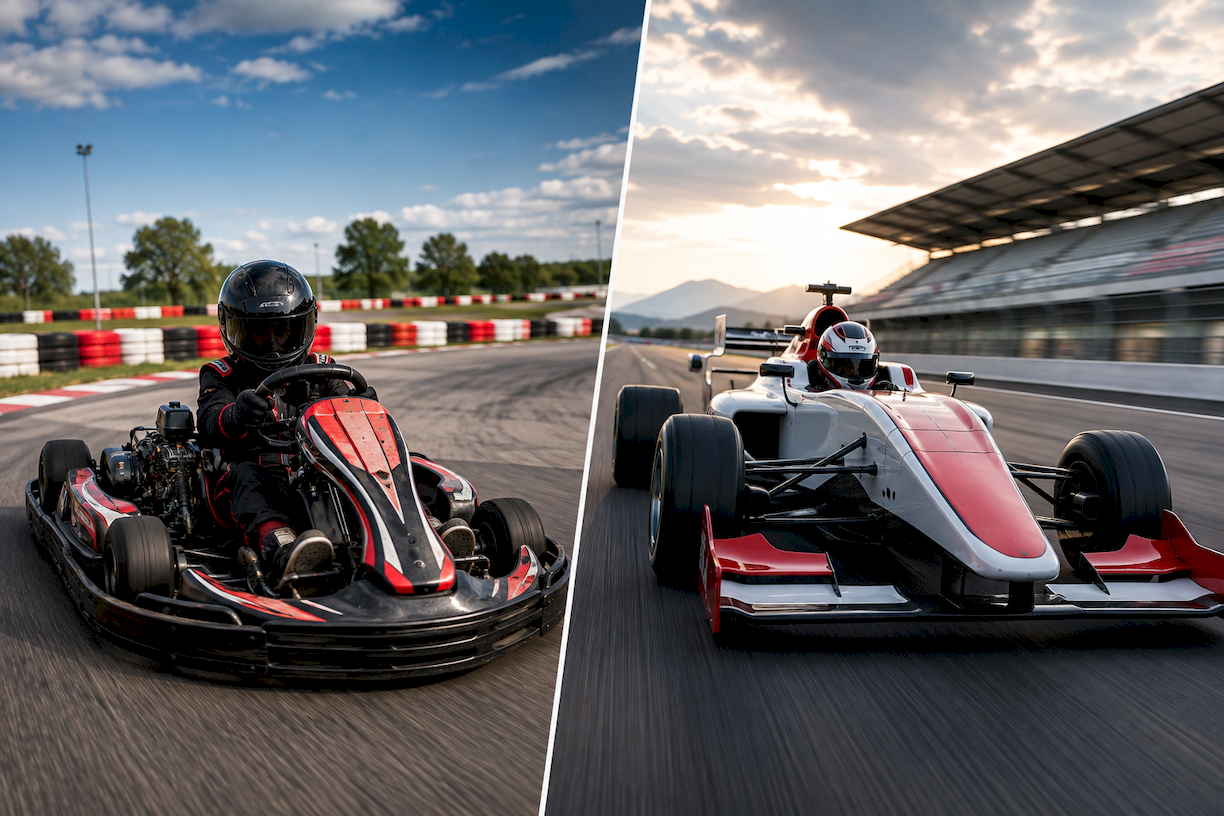
A go-kart is small, lightweight and relatively simple compared with a Formula car.
When you're sitting in a kart at Turbo Track, you're close to the ground and almost everything feels immediate. You can feel the steering, acceleration and braking directly.
A Formula car is a completely different machine.
It is designed specifically for high-performance racing and incorporates advanced engineering, suspension systems, aerodynamics, tyres and other technologies.
The car is also designed to generate significant aerodynamic performance at speed, something that changes the way the vehicle behaves through corners.
In simple terms:
A go-kart puts you close to the basics of driving.
A Formula car adds layers of engineering and technology on top of those basics.
2. Speed Is Another Major Difference
Formula racing is built around extremely high speeds.
Professional single-seater racing cars can reach speeds that are far beyond what you would experience in a recreational karting session.
Go-karts are considerably slower in terms of outright top speed.
But here's something interesting.
Because a kart is so small and close to the ground, it can still feel incredibly fast.
When you're sitting only a few centimetres above the track, a corner approaching at speed feels completely different from watching a race car from the outside.
This is one reason karting is such an exciting experience at Turbo Track.
You don't need Formula-level speeds to experience the adrenaline of racing.
3. Go-Karts Feel More Direct
One of the things that makes go-karting so enjoyable is how direct the vehicle feels.
There is very little separating you from the machine.
You turn the steering wheel, and the kart responds.
You brake, and you immediately feel the change in speed.
You accelerate, and you feel the kart build momentum.
That direct feedback makes karting a great way to understand basic vehicle control.
Formula cars, meanwhile, are much more complex.
The driver has to manage a much more sophisticated machine while dealing with higher speeds, greater braking forces, aerodynamic effects and other racing variables.
4. Formula Racing Depends Much More on Aerodynamics
This is one of the biggest technical differences between the two.
Aerodynamics plays a huge role in Formula racing.
Formula cars are designed to use airflow to generate downforce, which helps the car stay planted on the circuit at high speeds.
That means a Formula driver isn't only thinking about:
"Where should I brake?"
They're also dealing with how the car behaves at different speeds and how aerodynamic performance affects cornering.
Go-karting is much more straightforward in comparison.
While kart design, tyres and chassis setup can still make a difference, the aerodynamic complexity of a Formula car simply isn't there in the same way.
This allows beginners to focus more directly on fundamental racing skills.
5. Cornering Is Important in Both
Here's where go-karting and Formula racing become surprisingly similar.
In both, corners can make a huge difference to lap time.
A driver needs to understand:
- Braking points
- Racing lines
- Apexes
- Corner entry
- Corner exit
- Throttle control
- Steering inputs
The basic principle is also similar.
You don't necessarily want to enter every corner as fast as possible.
Instead, you want to find the right balance between entry speed and exit speed.
A clean exit can give you more speed down the next straight.
This is one of the reasons spending time on a karting track can help someone develop an interest in racing.
6. Karting Teaches You Racing Lines
One of the first things you start noticing as you improve at go-karting is that the fastest way around a corner isn't always the most obvious one.
You start experimenting with where you brake.
Then you notice where you turn.
Then you begin looking for the apex.
Eventually, you start thinking about where the kart needs to be when it exits the corner.
That is the racing line.
Formula drivers use the same basic concept, although the speeds, vehicles and circuits are far more complex.
At Turbo Track, even a casual race with friends can give you a taste of this.
You might start your first session simply trying to stay on the track.
By your next session, you're thinking about how to improve your line.
That's the beginning of thinking like a racer.
7. Braking Works Differently
Braking is important in both types of racing, but Formula cars operate at a completely different level.
Professional race cars can brake from very high speeds in extremely short distances.
The forces involved are intense.
Go-karts operate at much lower speeds, making the braking experience more approachable for recreational drivers.
But the basic principle remains:
Brake with control, turn smoothly, and prepare for the corner exit.
If you brake too late in a kart, you may run wide.
If you brake too early, you may lose unnecessary momentum.
Finding the balance is part of learning how to drive faster.
8. Physical Demands Are Different
Don't let the small size of a go-kart fool you.
Karting can be physically demanding.
You're constantly steering, braking, accelerating and reacting to the track. Even a relatively short session can leave you feeling like you've had a proper workout.
Formula racing takes the physical demands to another level.
Professional drivers need exceptional fitness, particularly in areas such as:
- Neck strength
- Core strength
- Endurance
- Reaction ability
- Concentration
They may experience significant forces while braking and cornering at high speeds.
So while a recreational karting session and a professional Formula race aren't comparable in physical intensity, both require concentration and physical control.
9. The Tracks Are Different
Go-karting tracks are usually smaller and more compact than major Formula circuits.
That's not necessarily a bad thing.
A compact track means you're making decisions constantly.
There may be corners close together, quick changes in direction, tight turns and short straights.
Formula circuits are much larger and can include long straights, high-speed corners, technical sections and significant elevation changes.
At Turbo Track, the focus is on giving drivers an exciting racing environment where they can experience different aspects of karting without needing to be professional racers.
That makes it a great option for people who simply want to experience the thrill of racing.
10. Formula Racing Is Far More Expensive
This is one area where there is a huge difference.
Go-karting is comparatively accessible.
You can arrive at a karting facility, get your safety briefing, put on your required gear and get on the track without owning a racing vehicle.
Formula racing is a completely different world financially.
Professional motorsport involves:
- Race cars
- Transport
- Mechanics
- Engineering
- Tyres
- Fuel
- Spare parts
- Testing
- Team personnel
- Competition fees
At the professional level, the costs can become enormous.
This is another reason karting is often considered an entry point for people interested in motorsport.
You can experience racing without immediately stepping into the financial world of professional motorsport.
Can Go-Karting Help You Become a Better Racer?
Absolutely.
That doesn't mean that driving a kart automatically prepares someone to jump into a Formula car.
There is a lot more to professional motorsport.
However, karting can help develop several fundamental skills.
Racecraft
You learn how to race around other drivers, look for opportunities and defend your position.
Racing Lines
You start understanding how positioning affects speed.
Braking
You learn to judge braking points and control your speed into corners.
Reaction Time
You constantly respond to changes around you.
Concentration
You have to remain focused throughout the session.
Consistency
You learn that a fast lap isn't enough. You need to repeat good laps.
Competition
You experience the pressure and excitement of racing against someone else.
These are valuable foundations for anyone interested in motorsport.
Why Karting Is Often the First Step in Motorsport
If you look at the career paths of many professional racing drivers, karting appears early in their journey.
That's not a coincidence.
Karts allow young drivers to learn many of the fundamentals of racing without immediately dealing with the complexity of a full-size race car.
They learn how to race.
They learn how to find speed.
They learn how to deal with competition.
And perhaps most importantly, they learn how much precision is involved in going fast.
Not everyone who enjoys karting wants to become a professional driver, of course.
And they don't have to.
For most people, karting is simply an exciting activity to enjoy with friends, family or colleagues.
But if you're someone who dreams of going further in motorsport, karting can be a very interesting place to start.
Go-Karting at Turbo Track: Experience the Basics of Racing
You don't need a Formula car to understand why racing is so addictive.
At Turbo Track, you can get behind the wheel, feel the kart respond to your inputs and experience the challenge of competing against other drivers.
Maybe your first goal is simply to complete the race.
Then you start trying to beat your friend's lap time.
Then you begin thinking about your braking points.
Then you're looking at the racing line.
Before you know it, you're discussing which corner you lost time in.
That's the fun part.
Karting lets you experience the competitive side of motorsport in a way that is accessible and exciting.
Whether you're visiting Turbo Track for a casual outing or you're genuinely interested in developing your racing skills, every session gives you another opportunity to improve.
Go-Kart Racing vs Formula Racing: Which One Is Better?
There isn't really a "better" option.
They are designed for different purposes.
Go-karting is more accessible, compact, direct and beginner-friendly.
Formula racing is a professional motorsport discipline involving sophisticated cars, advanced engineering and much higher speeds.
But they share the same heart:
Find the fastest line. Control the machine. Make smart decisions. Race the person beside you.
And that's exactly what makes karting such a great introduction to motorsport.
Final Thoughts
The difference between go-kart racing and Formula racing goes far beyond the size of the vehicle.
Formula racing brings extreme speed, advanced aerodynamics, sophisticated engineering and professional-level physical demands.
Go-karting strips the experience back to something more direct.
You have a kart, a track, a steering wheel, a throttle, a brake and a driver trying to find every possible advantage.
That simplicity is actually what makes karting so special.
At Turbo Track, Gurgaon, you can experience that competitive feeling for yourself. You can work on your racing line, improve your braking, challenge your friends and see how quickly you can improve from one session to the next.
And who knows?
Maybe your first few laps at Turbo Track won't look anything like a Formula race.
But you'll understand one thing they have in common:
The moment the lights go out, everyone wants to be first.
Ready to experience the thrill of racing? Visit Turbo Track and get behind the wheel for your next go-karting adventure.